I’d never seen Mountain Ringlets before, so continuing the theme of seeing more butterflies this year, I drove north and visited Ben Lawers today. The great variety of mountain plants is why Ben Lawers NNR has been in the care of the National Trust for Scotland since 1950. It’s also why it has multiple designations for its natural heritage.
Ben Lawers NNR has the most extensive populations of arctic-alpine plants in Britain. Some of the species and communities at Ben Lawers are extremely rare and threatened. Of the flowering plants and ferns on the reserve, 13 are classified as nationally rare. The site is equally, if not more, important for its lower plants, the lichens and bryophytes (liverworts and mosses). With over 600 species recorded, again including a concentration of national rarities, Ben Lawers is arguably the most important individual site for lichens in Britain.
Over 30 nationally rare mosses and 5 nationally rare liverworts have been recorded at Ben Lawers NNR, which puts the importance of the site for bryophytes in perspective. Several mosses are found nowhere else in Britain, eg Roaldia revoluta.
It is also home to the Mountain Ringlet and is our only true montane species, and is found on mountains above 550m amidst the spectacular scenery of the Scottish Highlands.
I arrived at the site just after lunch and started the walk up the gravel path through the tree line . An Osprey flew overhead and Tree pipits were seen on the way up.

I eventually made it up to the area where the Mountain Ringlets were meant to be.
I spent the next two and a half hours walking around this hillside only seeing a few Small Heath butterflies, which was due to it being overcast. As I sat on the hillside, a glimmer of hope, the sun was breaking through.
As I started walking again and the sun broke through, a Mountain Ringlet appeared out of the long grass and landed.
At last I had connected!
5 individually Ringlets were seen in the next half hour, but they never stayed still long enough for any better photographs. I was just happy I had found them and they were on the list!
The walk down was much more pleasant having seen the Mountain Ringlets and thankfully the sun had appeared and made the walk worthwhile.
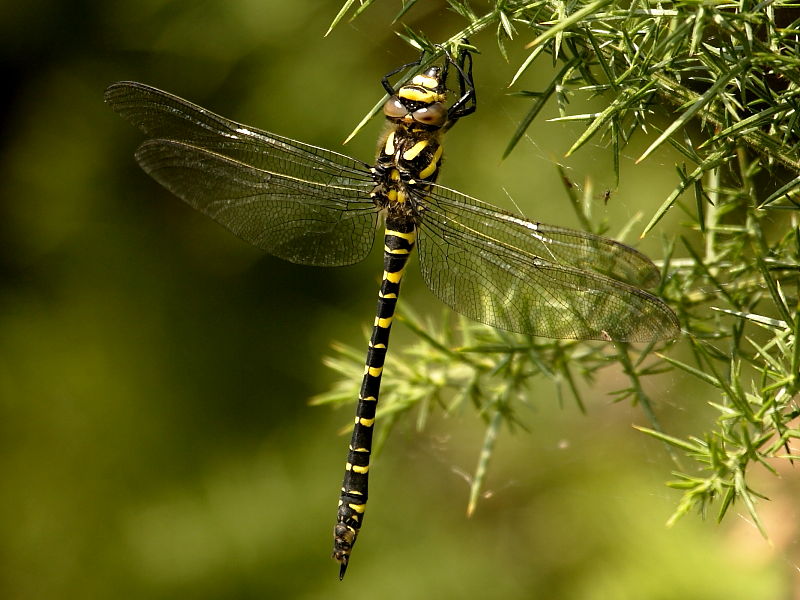
After the walk down I visited a nearby loch in the evening sun and managed to see these two beauties!
Common Darter
Black Darter


.JPG)