Wednesday, February 15, 2012
Monday, June 06, 2011
Thursday, February 17, 2011
SLATY BACKED GULL-RAINHAM MARSHES-LONDON 17/02/2011
After finally connecting with the Oriental Turtle Dove, we all celebrated with a whisky from the Doc’s hip flask at 8:00 am—a perfect start to the day. Our next target was the Slaty-backed Gull at Rainham Marshes. Arriving in London around 10:30 am, it was clear we were late to the party; birders were leaving, including Dan Pointon, who had been searching since first light.
As we set up our scopes and scanned toward the tip, Chris Batty came running past, shouting that the gull was now on Wennington Marsh. A stampede ensued! I rang Dan while sprinting across the marsh; he had just walked back from the site and had no idea the bird had moved. Pushing through the crowd of at least 100 birders, I finally spotted Dan on top of the hill and gave one last sprint. There it was, perfectly still in his scope!
The Slaty-backed Gull sat serenely in the middle of the marsh, preening occasionally and lifting its head to glance around. We were ecstatic—after another frustrating day in January spent scanning in vain, we finally had the bird in the bag. Native to eastern Siberia and northern Japan, this species winters along the coasts of Japan, Korea, and China, making it an exceptionally rare vagrant to Western Europe. Seeing it in the flesh, so far from its normal range, was a truly unforgettable experience.
We enjoyed half an hour of superb views before heading back to the car, whisky in hand once again, to toast the success. Now, all that remained was to wait and see if the BBRC would accept the record.


Slaty-backed Gull

Me, knackered after running halfway around the reserve

Birders on site
ORIENTAL TURTLE DOVE-41 THE LEYS-CHIPPING NORTON-OXFORDSHIRE
Tuesday 15th December
A first-winter Oriental Turtle Dove that first appeared in Chipping Norton, Oxfordshire, in mid-December 2010, was relocated on Saturday morning in a different garden. The bird had been feeding alongside Collared Doves and Woodpigeons on seed scattered on the lawn, often coming within just 10 feet of the window—an incredible opportunity for close-up observation. Native to East and Southeast Asia, this species breeds across Russia, China, Japan, and Korea, and winters in Southeast Asia.
The homeowner generously allowed public access on Tuesday, 15 February, from 10:00 am to 4:00 pm, for a small fee of £5 per person.
I made plans to meet up with Phil Woollen, Malcolm Curtin, and Mark Payne and aimed to arrive at first light. Upon arrival, we found around 300 twitchers already on site, so we joined the queue and prepared for what promised to be a memorable day of birding.

It was going to be a long day
The bird made a brief appearance before flying off with two Collared Doves. We spent the next nine hours walking the streets of The Leys, expecting it to return at any moment, but it simply didn’t happen. Despite the extreme generosity of many local residents, who kindly allowed us into their back gardens for a better view, the dove failed to reappear for the rest of the day.
Needless to say, we were gutted—sometimes even the rarest and most eagerly chased birds can be frustratingly elusive. Still, the experience of being part of such a remarkable twitch and witnessing the dedication of fellow birders made it a day to remember.
Wednesday 16th Feb
While out with the family in Llandudno, the mega alert went off twice. The Slaty-backed Gull had reappeared at Rainham Marshes—a bird I had dipped on back in January—and the Oriental Turtle Dove was reportedly showing well. However, the owners had stated that no one would be allowed into the garden until Friday, which made the whole situation incredibly frustrating.
Determined not to miss it, I quickly arranged a team for the following morning, consisting of Pete Antrobus, Malc Curtin, and Doc Brewster, to maximise our chances of connecting with this elusive visitor.
Thursday 17th February
I drove to Pod’s house, who was taking the wheel today, and we picked up Malc and Doc Brewster before setting off south. We arrived just after 7:00 am and were the first birders on site. At first, it didn’t look promising—the family apparently wasn’t letting anyone in, and the curtains were firmly shut.
Pod and I decided to walk down the road and check a few other gardens, but came up empty-handed. On returning, we couldn’t believe it: Doc and Malc had somehow managed to get inside the house. Malc later explained he’d tried to phone us, but thanks to a poor O2 signal, we never received the call—classic!
Thankfully, the bird was right there in the kitchen as we entered. The owner’s wife was calmly eating her toast, with the children getting ready for school, completely unaware of the chaos happening around them. At last, after all the waiting and uncertainty, we finally had excellent views of the Oriental Turtle Dove.

Oriental Turtle Dove
Wednesday, November 10, 2010
PIED BILLED GREBE HOLLINGWORTH LAKE-GREATER MANCHESTER 10/11/2010
With two Pied-billed Grebes earlier in the year in Ireland, the possibility of one turning up on the mainland seemed real, and thankfully, it has! The bird was originally discovered by an RSPB group three days ago. Initially thought to be a Red-necked Grebe, photographs later confirmed the correct identification.
I made my way to Hollingworth Lake with Malc Curtin, as everyone else had seen the bird the previous day while we were at work. On arrival, we connected with the grebe straight away. While the bird was not particularly showy, it was a valuable addition to the list, and I was surprised it had been misidentified; the differences with a Red-necked Grebe are clear.
This marks the first sighting of a Pied-billed Grebe on the UK mainland since 2001, when one was at Upper Tamar Lake, Cornwall/Devon from 8th January to 24th February. A rare and exciting record for Greater Manchester!


Pied Billed Grebe

Hollingworth Lake

Me on site
Tuesday, September 14, 2010
Barolo Shearwater-Meols-14th September 2010
Where do I even start? After a well-earned lie-in following a night shift, Allan Conlin phoned with thrilling news: a Wryneck had been found on the North Wirral coast. I got myself ready and soon arrived on site. The bird was flighty at first, but we eventually located it sitting low in a bush, allowing us some good views.
After soaking in the moment, Allan and I decided to try a seawatch off Meols Promenade. Scopes set up, we quickly connected with our first Leach’s Petrels of the year, followed by a Black Tern. Then came the moment that sent my heart racing: Allan shouted, “OH SHIT!”
“What have you got?” I asked.
“LITTLE SHEARWATER!”
I managed to get on the bird immediately and could hardly believe my eyes. Watching it glide past was utterly surreal; I was in complete shock! Thankfully, Allan had seen this species recently in Lanzarote, so he was able to pick it up while I was distracted on the phone, constantly calling out details about the bird’s jizz as it passed. It was one of those magical birding moments you never forget.
Historical Context: Little Shearwater is extremely rare in the UK. If accepted, this will be only the second record for Cheshire and Wirral, the first being at Rostherne Mere in 1977 (June 29th–July 2nd). That bird was initially thought to be a Manx Shearwater until it became sick and was subsequently examined; it now resides in Manchester Museum.
This sighting was a reminder of the thrill of seabird watching: patience, teamwork, and a little luck can deliver experiences you’ll remember for a lifetime.

Me And Al After Our Great Find


Wednesday, September 01, 2010
EASTERN OLIVACEOUS WARBLER OLD FALL PLANTATION-FLAMBOROUGH HEAD-EAST YORKSHIRE 01/09/2010
Just as I was leaving work this afternoon, the pager went off: “Eastern Olivaceous, Flamborough Head!” Adrenaline kicking in, I quickly made arrangements and picked up Malc Curtin along the way. The drive northeast was swift, and within three hours, we arrived on site, but the bird proved elusive.
After a tense twenty-minute wait, the warbler finally revealed itself, flitting among the branches of an apple tree. We were rewarded with superb views, noting its strikingly long bill and pale plumage. Witnessing this bird was thrilling—it’s notoriously tricky to pin down in Britain, and this sighting marks the first record for East Yorkshire.


Birders On Site
There are 18 previous records of this species in Britain and Ireland
2009 Jun 21 Shetland 1 day Plantation and Chalet, Fair Isle, 21st June, trapped, photo.
2008, Sep 23 to Sep 25, Shetland 3 days Harrier, Foula, first-winter, 23rd–25th September, photo.
2008 May 17 Dorset 1 day Portland BO, 17th May, trapped, photo.
2006 Sep 24 to Oct 1 Co.Cork 8 days Cape Clear Island, 24th September to 1st October, photo.
2003 Aug 31 Dorset 1 day Portland, first-winter, trapped, 31st August, photo.
2002 Aug 24 Essex 1 day Dengie, trapped, 24th August, photo (Birding World). Pending / not submitted
2002, Aug 18 to Aug 28 Shetland 11 days Sandwick/Hoswick, Mainland, adult, 18th to at least 28th August, trapped 18th August, photo.
2000 Sep 13 to Sep 21 Aberdeens 9 days Collieston, 13th to 21st September, trapped 15th September, photo.
1999 Sep 18 to Oct 9 Co.Cork 22 days Cape Clear Island, first-winter, trapped, 18th September to 9th October.
1999 Jul 4 to Jul 5 Dorset 2 days Portland Bill, 4th to 5th July, trapped 4th July.
1998 Sep 24 to Oct 8 Isles of Scilly 15 days St Agnes, 24th September to 8th October, photo.
1995 Aug 12 to Aug 13 Suffolk, 2 days Benacre, 12th to 13th August, photo.
1995 Jun 5 to Jun 13 Shetland, 9 days Fair Isle, 5th to 13th June, trapped 5th June, photo.
1985, Oct 17 to Oct 27 Isles of Scilly, 11 days St Mary's, 17th to 27th October, photo.
1984, Oct 16 to Oct 26 Isles of Scilly, 11 days St Mary's, 16th to 26th October, photo.
1977 Sep 16 Co. Cork 1 day Dursey Island, trapped, 16th September, photo.
1967 Sep 27 Kent 1 day, Sandwich Bay, trapped, 27th September.
1967 Sep 24 to Sep 26 Fife 3 days
Isle of May, trapped, 24th to 26th September, when killed by Great Grey Shrike Lanius excubitor, now at National Museums of Scotland (NMSZ 1968.73).
Watching this elusive species finally appear was a reminder of why birding combines patience, persistence, and a bit of luck—moments like this are what make the chase so exhilarating.
Monday, August 16, 2010
SYKES`S WARBLER DRURIDGE BAY-NORTHUMBERLAND 16/08/2010
News of a Booted Warbler in Northumberland had me holding out hope; it could be a Sykes’s Warbler, a lifer I’d been chasing for a long time. By late afternoon, good photos confirmed the identification, and the Mega alert finally went off… at 10:00 pm. Unfortunately, I was stuck at work on a night shift. I felt gutted, thinking the bird would vanish overnight.
After a few frantic phone calls, a kind nurse offered to cover my early shift so I could leave at 7:00 am. With fingers crossed, I waited for confirmation. Thankfully, the bird was still present by morning, so I set off on the long journey northeast.
I arrived at Duridge Bay at 10:30 am, and luck was on my side; the Sykes’s Warbler appeared almost immediately. It was a cracking record for the mainland, and the bird gave fantastic views while on site.
After soaking in the moment and chatting with fellow birders, I began the long journey home, content with adding another rare British species to my list. It was truly a privilege to see such a rare species on the mainland, and the experience reminded me why birding is such a thrilling mix of patience, persistence, and luck.
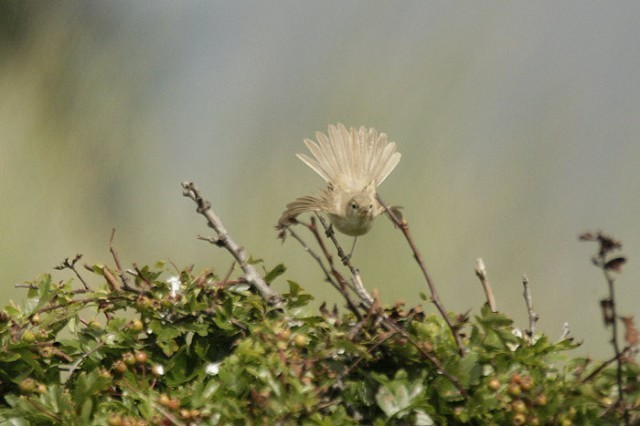

 Pictures kindly given to me by Tom Tams
There have been 12 previous records of this species in Britain and Ireland
2009 Sep 29 to Sep 29 Co. Durham 1 day or Booted Warbler: Marsden Quarry, 29th September.
2008 Sep 25 Shetland 1 day Sumburgh Head, Mainland, probably first-winter, 25th September, photo.
2003 Oct 4 to Oct 8 Shetland 5 days Baltasound, Unst, 4th to 8th October, trapped 5th October, photo.
2003 Sep 29 to Oct 1 Orkney 3 days North Ronaldsay, 29th September to 1st October, trapped 29th September.
2002 Aug 31 Sussex 1 day Beachy Head, 31st August, photo.
2002 Aug 26 Orkney, 1 day North Ronaldsay, trapped, 26th August, photo.
2002 Aug 23 Norfolk 1 day, Sheringham, 23rd August, photo.
2000 Jul 1 Dorset 1 day Portland Bill, trapped, 1st July, photo.
1993, Oct 22 to Nov 9, Shetland, 19 days, Seafield, Lerwick, Mainland, adult, 22nd October to 9th November, trapped 24th October, photo.
1990 Oct 17 Co. Cork 1 day Cape Clear Island, 17th October, photo.
1977 Aug 20 to Aug 27 Shetland 8 days Fair Isle, first-winter, 20th to 27th August, trapped 20th August, photo.
1959, Aug 29 to Aug 31, Shetland 3 days, Fair Isle, adult, 29th to 31st August, trapped 29th August.
Subscribe to:
Posts (Atom)