Fatbirder's Top 1000 Birding Websites

Saturday, January 31, 2026

CHESHIRE AND WIRRAL BIRD NEWS


31st Jan

2 Avocet and 2 Woodcock-Burton RSPB

Short-eared Owl- again off The Harp Inn-Neston Marsh

4 Russian White-fronted geese-In field west of the fishing lake; park on Dragon Lane-Kinderton

Shore Lark-In field by the wall along the Gritstone Trail between the telephone mast and the Old Man O'Mow-Mow Cop

30th Jan

Caspian Gull-Two: 1st-winter again on River Mersey sandbank west of old Runcorn Bridge yesterday morning and 1st-winter on roof at WSR Recycling Centre-Widnes

Greater Scaup (Drake) - West Kirby Marine Lake

29th Jan

Eurasian Bittern-Still in Coward Reedbed-Marbury Park-Northwich

4 Russian White-fronted geese-In field west of the fishing lake; park on Dragon Lane-Kinderton

Siberian Chiffchaff-One in control meadow-Pickerings Pasture

Shore Lark-In field by the wall along the Gritstone Trail between the telephone mast and the Old Man O'Mow-Mow Cop

28th Jan

Eurasian Bittern-Still in Coward Reedbed-Marbury Park-Northwich

2 Water Pipit-Neston Marsh

2 Short-eared Owl-Off Old Baths car park-Parkgate

Greater Scaup (Drake) - West Kirby Marine Lake

Shore Lark-In field by the wall along the Gritstone Trail between the telephone mast and the Old Man O'Mow-Mow Cop

27th Jan

Shore Lark-In field by the wall along the Gritstone Trail between the telephone mast and the Old Man O'Mow-Mow Cop

Greater Scaup (Drake) - West Kirby Marine Lake

Western Cattle egret-Bradley Orchard Farm-Frodsham

10 Western Cattle egret-Yesterday-Ince

26th Jan

Eurasian Bittern-In flight over Coward Reedbed-Marbury Park-Northwich 

Short-eared Owl, One of station road-Burton marsh

Caspian Gull-1st-winter on River Mersey off Spike Island-Widnes

Siberian Chiffchaff-Still in bushes immediately north of filter beds at sewage works; view from mound at north side-Glazebury

Shore Lark-In field by the wall along the Gritstone Trail between the telephone mast and the Old Man O'Mow-Mow Cop

25th Jan

Shore Lark-In field by the wall along the Gritstone Trail between the telephone mast and the Old Man O'Mow-Mow Cop

Greater Scaup (Drake) - West Kirby Marine Lake

Russian White-fronted goose-Two at 53.1633,-2.4202-Kinderton

Tundra Bean Goose-One still at Withington Hall pool; also 2 Russian White-fronted geese. Park on Catchpenny Lane and walk north along the footpath to view from the south side of the lake-Chelford, this morning than no sign

Siberian Chiffchaff-Still at sewage works; view from mound at north side-Glazebury

Eurasian Bittern-One roosted in the reedbed viewed from New Viewpoint-Neston Marsh

Eurasian Bittern-In flight over Coward Reedbed-Marbury Park-Northwich 

24th Jan

7 Great White Egret and 5+ Marsh Harrier-Burton Marsh

Mediterranean Gull-River Mersey-Wallasey

Mediterranean Gull
(c)Pete Sutton

Eurasian Bittern-One in Coward Reedbed at dusk-Marbury Park-Northwich

Shore Lark-In field by the wall along the Gritstone Trail between the telephone mast and the Old Man O'Mow-Mow Cop

Shore Lark
(c) Steve Seal

Tundra Bean Goose-Two still at Withington Hall pool; also 3 Russian White-fronted geese. Park on Catchpenny Lane and walk north along the footpath to view from the south side of the lake-Chelford

Tundra Bean Goose
(c) Chris Harris

Russian White-fronted goose-Redes Mere

Greater Scaup (Drake) - West Kirby Marine Lake

Greater Scaup 
(c)Pete Sutton

Join Today-Click On Image

Friday, January 30, 2026

A NORTH AMERICAN VISITOR AT DORNOCH-HIGHLANDS-SCOTLAND

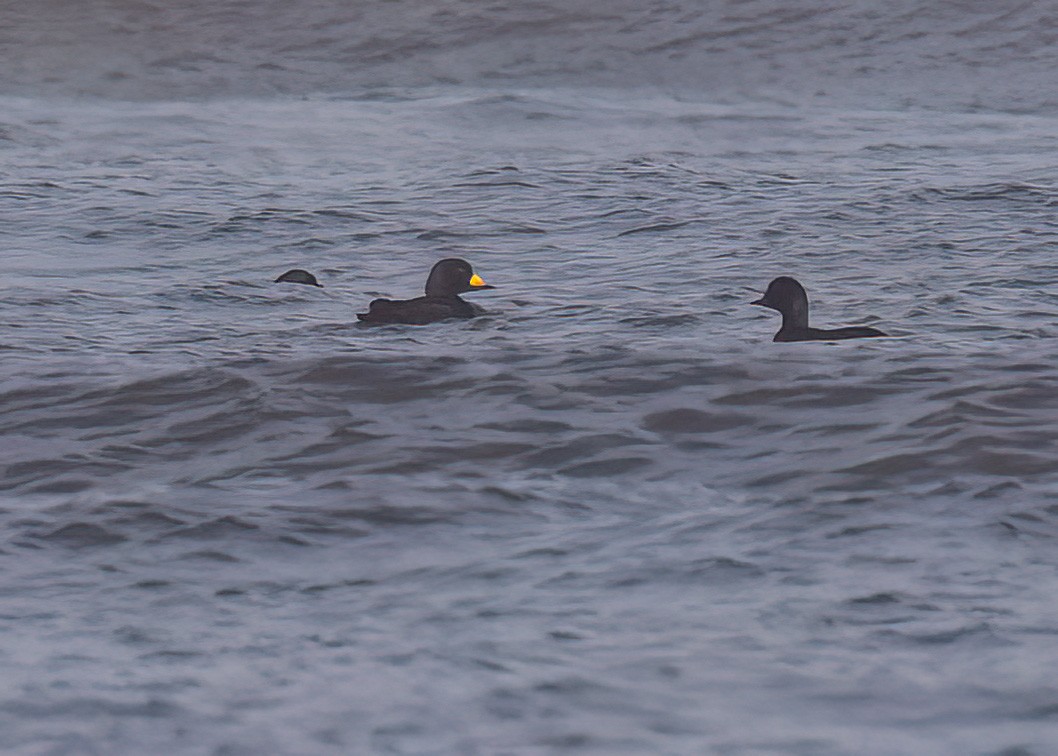
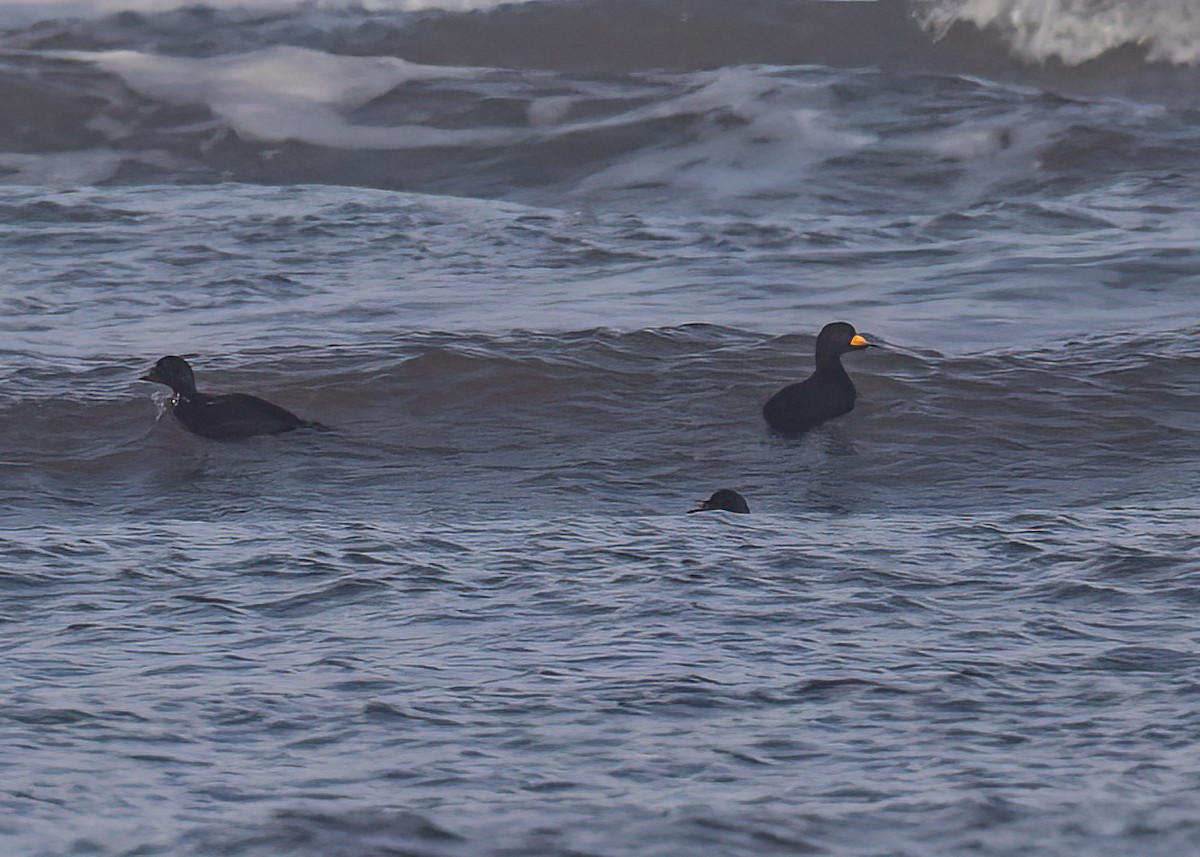
Last Sunday, while travelling north towards Wick, Caithness, I had planned to stop at Dornoch to look for a Black Scoter, an uncommon North American vagrant and a species still required for my Scottish list. The bird had been present for approximately a month, associating with a flock of Common Scoters offshore. Black Scoter breeds across Alaska and northern Canada and winters along the Atlantic and Pacific coasts of North America; only small numbers reach Britain each year, most frequently along northern and western coasts and usually in the company of Common Scoters.

However, reports that the Bonaparte’s Gull was still present at Gairloch prompted a change of plans and a diversion west. This afternoon, after work, I returned to Dornoch to pursue the original plan. Scanning the scoter flock from the beach, the Black Scoter was eventually located after careful searching, allowing prolonged views and providing an excellent opportunity to study this scarce Scottish visitor.


Black Scoter
Black Scoter
(c)Graeme Risdon

Wednesday, January 28, 2026

FIRST MOTH RECORDS OF THE YEAR

With overnight temperatures remaining mild, I was able to run my moth trap for the first time this year, placing it in a local woodland in Ellesmere Port. On checking the trap the following morning, three moths were recorded. Two were Chestnut moths, while the third proved to be a Dark Chestnut moth, a welcome first record for me. An encouraging start to the season.

Dark Chestnut

Chestnut

Both species together for comparison

Sunday, January 25, 2026

BIRDING THE LONG WAY TO WICK-CAITHNESS-SCOTLAND

After the previous day’s birding and a solid night’s sleep, I was up at 5am, packed and ready for a full day in the field. The plan was simple enough: head north towards Wick in Caithness and see what the Highlands had to offer along the way. As so often in Scotland, that plan would be happily derailed.

View from the A939 towards Nethy Bridge

My first stop was Nethy Bridge, deep in the heart of the Cairngorms, in search of one of Scotland’s true avian specialities: the Crested Tit. In Britain, this small but characterful species is almost entirely confined to the ancient Caledonian pinewoods of Strathspey and the surrounding Cairngorm massif. Here, mature Scots pines, rich in insects and deadwood, provide precisely the conditions the species requires, explaining both its stronghold in the area and its absence elsewhere following centuries of forest loss.

Parking up, I made my way quietly towards the feeders, and it wasn’t long before success came in the form of two Crested Tits. Their spiky crests and restless movements made for a brief but satisfying encounter, a fitting start to the day.

Heading north once more, my next destination was Cawdor Churchyard in Moray & Nairn, a well-known but perpetually atmospheric site for Hawfinch. 

On arrival, patience was barely required; two birds soon appeared, perching high and flying between the treetops. Stocky and powerful, Hawfinches have an unmistakable presence. Always an elusive species in Scotland, encounters like this are never taken for granted.

From woodland to coast, I then made my way to Chanonry Point on the Moray Firth. 

News of a developing Little Auk “wreck” along the east coast had drawn birders out in numbers. These tiny Arctic seabirds, scarcely larger than a starling, are particularly vulnerable to prolonged winter gales. Strong easterly winds can force them into the North Sea, where exhaustion and starvation often result in mass strandings and heavy mortality.

When I arrived, several birders were already scanning the choppy waters. Eventually, two Little Auks were picked up sitting on the sea, their compact black-and-white bodies bobbing between the waves. Another bird flew east past the point, offering excellent views of its rapid wingbeats and short, rounded wings. Despite their delicate appearance, seeing these birds so far from their high-Arctic breeding grounds is always a powerful reminder of the forces at play in winter seas.

The supporting cast at Chanonry was impressive: a Green-winged Teal among the dabbling ducks, a sleek Black-throated Diver, three Red-throated Divers, a smart Slavonian Grebe, and good numbers of Eider and Long-tailed Ducks, all contributing to the sense of a coast alive with winter movement.

Green-winged Teal

Just as I was preparing to continue north towards Wick, news broke that a Bonaparte’s Gull was still present at Gairloch on the west coast, around an hour and a half away. An adult bird feeding around a fish farm, and one I still needed for my Scottish list. The decision was instant.

Driving towards Loch Maree

The drive west delivered classic Highland scenery, and I arrived at the fish farm shortly after 2.30pm. A noisy flock of Black-headed Gulls was feeding eagerly at the outflow, and after a careful scan, the target bird appeared, flying in and settling on the rocks. Smaller and more elegant than its European cousin, the adult Bonaparte’s Gull breeds in the boreal forests of Canada and Alaska. The species normally winters along North America’s coasts, making any Scottish record a notable event.


Another birder arrived and quickly connected with the gull, and as we watched, a third-winter Iceland Gull joined the feeding frenzy, an excellent bonus to an already memorable stop.


Only later did reality intrude. Entering my accommodation into the sat nav revealed a three-hour drive back to Wick. A long haul, certainly, but after a day that had delivered pinewood specialities, elusive finches, storm-driven seabirds and a transatlantic gull, there was little room for complaint.

It had been a remarkable day’s birding, and a perfect reminder of why Scotland, at its wild and unpredictable best, remains so hard to beat.

BIRDGUIDES REVIEW OF THE WEEK:19TH-25TH JANUARY 2026

January can often feel like one of the more sedate British and Irish birding months, so few would have predicted the phenomenal start to 2026. Read more>

Saturday, January 24, 2026

WINTER RARITIES ON THE ROAD NORTH-TAIGA BEAN GOOSE AND A LONG STAYING DOWITCHER-SCOTLAND

A last-minute call confirming three weeks of work in Caithness, Scotland, was enough to get me out of Cheshire at silly o’clock, turning the long drive north into an unexpected birding opportunity. With a free weekend ahead, the obvious plan was to make the most of it en route.

My first stop was the Slamannan Plateau, the UK’s main wintering site for Taiga Bean Goose. I counted 38 birds, a reassuring sight at a site I hadn’t visited since 2007. 


A rare winter visitor from Scandinavia and northern Russia, only a few hundred Taiga Bean Geese spend the winter in Britain, making Slamannan a site of national conservation importance. Seeing the flock still returning in good numbers felt quietly significant.

Slamannan

Continuing north, I called in at Montrose Basin, the enclosed estuary of the River South Esk in Angus. Covering some 750 hectares of tidal mudflats, the basin offers feeding and roosting habitat for a wealth of birdlife and is rightly regarded as one of Scotland’s premier wetland sites. It also happens to be my mate Dan Pointon’s local patch.

Montrose Basin-Rossie Spit

Dan’s hospitality came with a timely bonus: the long-staying Long-billed Dowitcher at Rossie Spit, which he originally found on 15 October, was still present. A scarce Nearctic wader, Long-billed Dowitcher breeds in Alaska and northern Canada and winters mainly in the southern United States, Central America and the Caribbean, with only occasional individuals reaching Britain. The bird showed well, feeding calmly, a smart first-winter, with softly marked grey-brown upperparts and clean underparts typical of the age, and a very welcome addition to my Scottish list.

A work trip may have provided the excuse, but it was these short detours that turned the journey north into something far more memorable.

Friday, January 23, 2026

A GRACKLE IN GARSTON-LANCASHIRE

It began, as these things so often do, with a casual comment from a dog walker. He mentioned to a local patch birder that he’d seen a “strange bird” in the area. The remark lingered, and a couple of weeks later, it paid off. After some patient groundwork, @jackbirder finally pinned the bird down at dusk at Speke Hall Estate, confirming that something decidedly unusual had been present for some time.

The news spread quickly: the bird was believed to be a probable male Great-tailed Grackle, a remarkable record, surely another boat-assisted one that was frequenting a wet copse at the north end of the northernmost meadow at Speke Hall Estate, where it had been associating with Magpies. Given the likelihood that it had already been in the area for up to two weeks, anticipation built overnight.

When the finder relocated the bird again the following morning, Jenna and I made our way to Speke Hall. A small gathering of birders assembled, scanning the copse intently. An hour passed with no sign. 

The copse

Me casually waiting for the Grackle to put in an appearance

Then, suddenly, the bird flew in from the west, landing at the top of the copse and finally revealing itself.

Probable male Great-tailed grackle

For those present, it was a timely reminder that the most extraordinary records can begin with the most ordinary of encounters, and that it always pays to listen when someone says they’ve seen a “strange bird”.

That said, without a definitive sample, caution remains advisable. In the absence of a DNA-confirmed dropping, it is perhaps safest to regard the bird as Grackle sp. for now. This follows last year’s situation at Calshot, Hampshire, where a bird initially identified as a Great-tailed Grackle was later re-assessed by some as a likely Boat-tailed Grackle, based on structural features such as a more raised crown and a weaker bill. Ultimately, a droppings sample confirmed that the bird was a Great-tailed.

Should the Speke Hall bird linger, it is hoped that further evidence may be obtained, allowing its identification to be confirmed beyond doubt. However, under the current policy of the British Ornithologists’ Union Records Committee, ship-assisted vagrants involving port-to-port or coast-to-coast transport are not eligible for inclusion on the British List. Suspected ship-assisted records may be considered only where the species concerned is regarded as capable of undertaking an unassisted transatlantic crossing under favourable meteorological conditions.

Thursday, January 22, 2026

A CRACKING HAMPSHIRE DOUBLE

When news broke early yesterday morning that a Killdeer had been found at Ripley Farm Reservoir in Hampshire, it immediately set pulses racing. A familiar and vocal plover across much of North America, the Killdeer is a genuine rarity on this side of the Atlantic, with only a handful of British records. The bird had lingered until dusk the previous evening, and with optimism high, plans were quickly set in motion.

I teamed up with birding mates Owen Parsons and Rob Pocklington, both of whom needed the bird as a lifer. Although I’d seen a Killdeer once before, back in September 2007 at the Pool of Virkie in Shetland, I still needed it for my England list, and the prospect of a day out birding was reason enough in itself.

Owen picked me up at a decidedly unholy 3:30am, and we rolled into Ripley just after 8am, encouraged by messages confirming the bird was still present. A brisk 15-minute walk brought us onto the site, where a few familiar faces were already watching the bird and quickly put us straight onto it.


And what a bird it was. Smart, alert, and that unmistakable double-ringed breast pattern leaving no doubt, the Killdeer looked every bit the New World plover it is.

Despite having seen one before, it was still a thrill to watch, and for Owen and Rob, especially, finally connecting with a long-wanted lifer was written all over their faces. A proper moment.

With spirits high, we turned our attention to the journey home, but not before making a detour to visit another transatlantic wanderer: the Great-tailed Grackle. This bold, glossy icterid is a familiar sight across Central and North America, where its range continues to expand northwards, yet in Britain it remains a notable rarity. This individual had already been present for some time, and I’d managed to connect with it last year.

On arrival, the bird didn’t disappoint, now frequenting a nearby housing estate and showing remarkably well. Its long keel-shaped tail, piercing eye, and confident demeanour made for excellent views. 

For both Owen and Rob, neither of whom had seen one before, it was another lifer safely in the bag, rounding off the day in style.

After that, it was simply a case of pointing the car north and reflecting on a day that had delivered everything you hope for from a rarity run. We eventually rolled back home just after 4pm, tired but buzzing, after what could only be described as a cracking day’s birding.

Tuesday, January 20, 2026

NORTHERN LIGHTS LIGHT UP SKIES ACROSS THE UK

Skies across the UK were recently illuminated with stunning shades of green and pink as the Northern Lights made a rare appearance.

Also known as the Aurora Borealis, this natural phenomenon occurs when eruptions from the sun send charged particles toward Earth. When these particles collide with gases in our atmosphere, they create the colourful light displays seen in the night sky.

Although the Northern Lights are usually visible near the Arctic Circle, periods of intense solar activity can push them much further south. This time, auroras were reportedly spotted as far south as northern Italy, southern Spain, and even the south of France.

I was alerted by a phone app earlier in the evening and managed to take a distant photo from outside my home. However, due to heavy light pollution where I live, the view wasn’t great. 

View from the back garden

Determined to see more, I headed down to Eastham Ferry on the River Mersey, where I was rewarded with clear and impressive views of the aurora glowing above John Lennon Airport in Liverpool.


Why Did This Happen?

Monday’s display was caused by a severe geomagnetic storm, triggered by a coronal mass ejection (CME) — a huge burst of charged particles released from the sun’s surface.

As these particles reached Earth, they interacted with gases in the atmosphere. Oxygen produced green light, while nitrogen created red, blue, and pink hues.

We are currently experiencing a phase known as solar maximum, part of the sun’s roughly 21-year cycle. During this time, the sun produces more sunspots, solar flares, and CMEs, increasing the chances of seeing auroras here on Earth.

Monday, January 19, 2026

CHESHIRE AND WIRRAL BIRD NEWS


23rd Jan

Shore Lark-In field by the wall along the Gritstone Trail between the telephone mast and the Old Man O'Mow-Mow Cop

Siberian Chiffchaff - Leasowe Lighthouse

Greater Scaup (Drake) - West Kirby Marine Lake

Russian White-fronted goose-Two between Warmingham Flash and Tetton Lane Marsh-Sandbach flashes

22nd Jan

Shore Lark-In field by the wall along the Gritstone Trail between the telephone mast and the Old Man O'Mow-Mow Cop

Siberian Chiffchaff - Leasowe Lighthouse

21st Jan

Caspian Gull-Adult-Elton Hall flash-Sandbach

Shore Lark-In field by the wall along the Gritstone Trail between the telephone mast and the Old Man O'Mow-Mow Cop

Russian White-fronted Goose-One still at Bradley Orchard Farm-Bradley-Frodsham

20th Jan 

Caspian Gull-Adult on Small Pool late morning, then flew south-east-Newchurch Common

Shore Lark-In field by the wall along the Gritstone Trail between the telephone mast and the Old Man O'Mow-Mow Cop

Scaup (drake)- West Kirby Marine Lake

19th Jan 

3 Short-eared Owl - Denhall Quay

Caspian Gull-Adult-Elton Hall flash-Sandbach

Shore Lark-In field by the wall along the Gritstone Trail between the telephone mast and the Old Man O'Mow-Mow Cop

Siberian Chiffchaff - Leasowe Lighthouse

Siberian Chiffchaff
(c)Sean O'Hara

Short-eared Owl off Golf Course, also 4 Great White Egret and c3,200 Lapwing - Parkgate

440+ Great Crested Grebe on flat calm sea over high tide -Leasowe


Sunday, January 18, 2026

BIRDGUIDES REVIEW OF THE WEEK:12TH-18TH JANUARY 2026

The New Year has had a little time to bed in now, and those 2026 year lists have started to level off. Read more>

CHESHIRE AND WIRRAL BIRD NEWS

18th Jan

Slavonian Grebe-Two still off the southern end-Hilbre

Shore Lark-In field by the wall along the Gritstone Trail between the telephone mast and the Old Man O'Mow-Mow Cop

Eurasian Bittern-Flew towards Old Baths car park-Parkgate

Eurasian Bittern-Burton RSPB

17th Jan

Scaup (drake)- West Kirby Marine Lake

Shore Lark-In field by the wall along the Gritstone Trail between the telephone mast and the Old Man O'Mow-Mow Cop

Siberian Chiffchaff-One still near the lighthouse-Leasowe

Short-eared Owl-Two again off The Harp Inn-Neston

16th Jan

Siberian Chiffchaff-One still near the lighthouse-Leasowe

Siberian Chiffchaff
(c)Sean O'Hara

Short-eared Owl-Three again off Old Baths car park-Parkgate

Shore Lark-One at the northern end of Marine Lake-West Kiby Marine Lake

Shore Lark-In field by the wall along the Gritstone Trail between the telephone mast and the Old Man O'Mow-Mow Cop


Shore Lark
(c) Steve Seal

Scaup (drake)- West Kirby Marine Lake

Russian White fronted goose-Two-Elton hall Flash-Sandbach

15th Jan

Siberian Chiffchaff-one calling from scrub behind main lake-Bidston

Greenshank by groyne, also at least 5 Chiffchaff, including a Siberian Chiffchaff - Leasowe lighthouse

Scaup (drake), 3 (2 drake) Goldeneye, 3 Red-breasted Merganser,11 Goosander and 23 Brent Geese - West Kirby marine lake

14th Jan

Scaup (drake) and 26 Brent Geese (including 2 dark-bellied)-West Kirby Marine Lake

Merlin - Riverbank Road-Heswall

23 Brent Geese by the causeway - Thurstsaton Shore

13th Jan

Scaup (drake)- West Kirby Marine Lake

3 Short-eared Owl - Denhall Quay

12th Jan

Caspian Gull-Near-adult roosted this evening-Rosethern Mere

Russian White-fronted goose- In roadside field by Mere Farm Quarry-Chelford

Ruddy Shelduck- Again on sandbank east of The Mersey Gateway Bridge-Runcorn

Siberian Chiffchaff-One at Dutton Locks (bird has been present since 28 December 2025)-Dutton

Caspian Gull-Three (3rd-winter and two 1st-winters) at Veolia Recycling Centre, Wallasey Bridge Road-Bidston

Siberian Chiffchaff-Still in trees by path to Holdcroft Hall near sewage works-Glazebury

Green-winged Teal-Drake still on Rosemary's Flash-Sanbch Flashes

Scaup (drake), 15 Brent Geese and 3 (2 drakes) Goldeneye - West Kirby Marine Lake

Bittern flew from Neston Reedbed at dusk - Parkgate

3 Short-eared Owl - Denhall Quay

Barn Owl - Burton Point

11th Jan

Caspian Gull-1st-winter at Veolia Recycling Centre, Wallasey Bridge Road- Bidston

1st-winter Caspian Gull
(c) Steve Williams

Scaup (drake), 11 Brent Geese, Goldeneye (drake) and a Red-breasted Merganser -West Kirby Marine Lake

Greater Scaup
(c) Pete Sutton

10th Jan

Ruddy Shelduck-Still on River Mersey off Spike Island, viewed from Wigg Island-Widnes

Siberian Chiffchaff-Still at sewage works; view from mound at north side-Glazebury

Caspian Gull-Two 1st-winters on River Mersey-Widnes

Russian White fronted goose-Two-Elton hall Flash-Sandbach

2 Short-eared Owl - Burton Marsh

Short-eared Owl
(c) Paul Ralston

Greenshank and 7,000 Knot, with several hundred Pintail -Thurstaston Shore 

Juv Kittiwake flew west - Dove Point-Meols

Mediterranean Gull - New Brighton

2 European White-fronted Geese in the field by the Bunker hide - Burton RSPB

Scaup (drake), - West Kirby Marine Lake

4 Short-eared Owl - Denhall Quay

9th Jan

Siberian Stonechat-Still at sewage works-Glazebury

Drake Greater Scaup - West Kirby Marine Lake

Russian White-fronted goose-Two-Burton RSPB

Drake Greater Scaup-Budworth Mere-Northwich

8th Jan

Drake Greater Scaup - West Kirby Marine Lake

Russian White fronted goose-Two-Elton hall Flash-Sandbach

Drake Greater Scaup-Budworth Mere-Northwich

7th Jan

Drake Greater Scaup- West Kirby Marine Lake

Russian White fronted goose-Two still in the field off A49 opposite Park Farm-Cholmondeley

Russian White fronted goose-Two-Elton hall Flash-Sandbach

Caspian Gull-Two (adult and 2nd-winter) on sandbank west of Silver Jubilee Bridge-Widnes

2nd Winter Caspian Gull
(c) Steve Tomlinson

Short-eared Owl-Denhall Quay-Little Neston

6th Jan 

Scaup (drake), 8 Brent Geese, 6 Goldeneye and 7 Goosander - West Kirby Marine Lake

Bittern (briefly), 4+ Great White Egret and 3+ Marsh Harrier -Parkgate

Drake Greater Scaup-Budworth Mere-Northwich

Caspian Gull-Three (two adults and 1st-winter) in roost-Rosetherne Mere

5th Jan 

2 Scaup. 20 Goosander. 4 Goldeneye and a Mediterranean Gull - West kirby Marine lake

Short-eared Owl - Parkgate

2 Greenshank by groyne - Meols shore

30 Brent Geese at high tide - Hoylake

4th Jan 

Caspian Gull-Three (two adults and 1st-winter) in roost-Rosetherne Mere

Hen Harrier-Ringtail flew east along the Manchester Ship Canal-Moore Nature Reserve

Russian White fronted goose-Three still in the field off A49 opposite Park Farm-Cholmondeley

3rd Jan 

2 Purple Sandpiper - New Brighton Marine Lake

17 (incl 13m) Goosander on Roodee Mere - Royden

130 Golden Plover off Boathouse Flash - Parkgate

1st winter Caspian Gull in high tide roost - Hoylake

22 Whooper Swan - Outer Burton Marsh

2nd Jan 

Ruddy Shelduck-still on River Mersey off Spike Island-Widnes

Russian White-fronted goose-Four at Bowdens Lock-Frodsham

c11,000 Dunlin in high tide roost, also 4 Rock Pipit - West Kirby Shore

c12 Goosander on Roodee Mere (present for a couple of days) - Royden Park

4 Goldeneye - West Kirby Marine Lake

Bittern flew from Neston Reedbed to roost off Parkgate at 16.30hrs.

2 Short-eared Owl and a Barn Owl - Denhall Quay

Drake Greater Scaup-Budworth Mere-Northwich

1st Jan 

Little Gull-1st-winter still at Budworth Mere and drake Greater Scaup-Budworth Mere-Northwich

Little Gull-Astbury Mere-Congleton

Caspian Gull-two (adult and 1st-winter) on sandbank-Widnes

5 Russian White-fronted Goose-Lordship marsh-Frodsham


Sunday, January 11, 2026

BIRDGUIDES REVIEW OF THE WEEK:5TH-11TH JANUARY 2026

Freezing conditions dominated before the violent arrival of Storm Goretti in south-west England on 8th, resulting in a wild mix of rain, wind, snow and ice across Britain and Ireland for the remainder of the week. Read more>