Fatbirder's Top 1000 Birding Websites
MEGA BIRD NEWS:12th August 2026--Black-winged Kite-Norfolk-Hempstead Marshes-Zitting Cisticola-Suffolk-Walberswick-Long-tailed Shrike-Gloucestershire-Eastleach Martin-Hudsonian Godwit-Suffolk-Manningtree-

Saturday, September 23, 2023

BAY BREASTED WARBLER-RAMSEY ISLAND-CANADA WARBLER-GOVAN'S HEAD-PEMBROKESHIRE-23RD SEPTEMBER 2023

The excitement of the previous days surrounding the Magnolia Warbler had quickly given way to apprehension. For those afflicted with compulsive twitching, success is rarely savoured for long; attention swiftly turns to the next possibility—or the one that might yet slip away. The Bay-breasted Warbler had remained on Ramsey Island throughout Friday, 22 September, showing well, and with a midday boat booked, the prospect of an American warbler double now felt very real. This was set against a backdrop of an unprecedented influx of Nearctic landbirds across western Britain and Ireland.

With the boat departing at 12.00, I arranged to collect Sean Cole en route, where he had been camping a few miles from the island. While travelling south, further remarkable news broke: a Canada Warbler had been discovered close to St Govan’s Head, near the still-present Magnolia Warbler, and by the same observer. Canada Warbler is a North American species, breeding in the boreal and mixed forests of eastern Canada and the northeastern United States, and wintering primarily in northern South America.

I reached Sean’s just after 9.30 a.m., where Trudy had breakfast ready—most welcome after a long drive. 

                                            Happy days

After eating, we made our way to the departure point and joined the familiar gathering of birders. While waiting, a Wryneck was located along the coastal footpath and showed well, providing a fine prelude to the day.

Wryneck 

The crossing to Ramsey Island was straightforward, and on arrival, we were briefed by the wardens before making our way uphill to overlook the farmhouse garden.


All aboard!
    

After a short wait, the Bay-breasted Warbler appeared, first in the garden and later showing exceptionally well on a stone wall.

It was a particularly fine individual, brighter and cleaner than many, and afforded prolonged views as it fed in willows and bracken alongside Goldcrests, a female Blackcap and several Chiffchaffs. The setting was superb, and the atmosphere relaxed, with only a brief distraction when a Peregrine passed overhead. The organisation of the visit was exemplary, and the assistance of the RSPB wardens was much appreciated. A police presence related to an incident the previous day involving unauthorised access by kayak, posing risks to seals and biosecurity.

This was only the second British record of Bay-breasted Warbler, the first having occurred at Land’s End, Cornwall, on 1 October 1995.


Birders are waiting for the first glimpse of the Bay-breasted warbler


As we stood in the sunshine, news of further American arrivals continued to filter through: Northern Parula on Scilly, Philadelphia Vireo on Barra, Ovenbird on Rùm, Tennessee Warbler in Ireland, along with multiple Red-eyed Vireos, Baltimore Oriole, Black-and-white Warblers in Gwynedd and others. Nearctic migrants seemed to be appearing almost continuously.

We left the island on the 14.00 boat and were back at the car shortly afterwards. Despite the short distance, the drive back to St Govan’s Head took over an hour along narrow, winding roads. On arrival, the contrast with Ramsey could not have been greater. Cars lined the verges, and large numbers of birders were packed into the willow scrub. The Canada Warbler had been elusive, and the atmosphere was tense.

We joined the crowd just as the bird made a brief appearance for a small number of observers, prompting a surge. Moving to the far end with Sam Viles, I eventually picked up the Canada Warbler moving high in the bushes before it dropped into view and then flew further along the scrub. Views were brief but diagnostic. Many present were less fortunate, managing only flight views or none at all, and frustration was evident.


Three Yanks in a week? Unbelievable!

With Sean having seen the bird well, we returned to the car. I dropped him back at his camper van and then headed north, arriving home shortly after 8.00 p.m.


Thursday, September 21, 2023

YANKMAGEDDON:AMERICAN WARBLERS IN THE WAKE OF HURRICANE LEE

The arrival of American landbirds this week has been on an extraordinary scale. Many birders had been watching the progress of Hurricane Lee as it tracked along the eastern seaboard of the United States, clearly a system of some significance. Even so, few anticipated the magnitude of what was to follow. In many respects, we found ourselves in uncharted territory. Birdguides’ weekly summary arguably captures the scale of events far better than any individual account, and their term ‘Yankmageddon’ seems an apt one.

Hurricane Lee is on its way to hit the UK mainland 

The first indication of what was to come appeared on the morning of 20 September, with the discovery of a Blackburnian Warbler on a remote and inaccessible Irish island. Later that morning, a photograph circulated on my WhatsApp group bearing the caption “Magnolia Warbler”. A species breeding across boreal and temperate forests of eastern Canada and the northeastern United States, and wintering mainly in Central America and the Caribbean, it is a bird that only a handful of British birders have encountered.

Moments later, the details followed: mainland Britain, near Pembroke in South Wales. Plans were hastily made to travel overnight and return the following morning.

I picked up Sean Cole on the M5, and we arrived at the St Govan’s Head car park at around 10.00 a.m. From there, it was a brisk 500-metre walk into the valley. Almost immediately, the bird showed. Few additions to a British list feel as satisfying as an American wood-warbler, and this individual did not disappoint, showing intermittently but well over the next hour and a half.


Magnolia Warbler

As we were watching the Magnolia Warbler, news broke of yet another discovery: a Bay-breasted Warbler on Ramsey Island, some 20 miles away. This species breeds in the boreal forests of Canada and the northern United States and winters primarily in northern South America, making it an even scarcer vagrant to Britain. Unsurprisingly, excitement among those present was immediate, but it was quickly tempered by reality. With heavy swell lingering after the storm, there was no prospect of boats running that day or the next.

Nevertheless, hope remained. While standing in the crowd, Adrian Webb managed to secure boat places for Sean and me on the Saturday morning. It would mean another return journey to South Wales and a 48-hour wait, but if the bird lingered, the opportunity would still be there.

Roll on Saturday.

Thursday, August 17, 2023

RED FOOTED BOOBY-BISHOPS ROCK-ISLES OF SCILLY-17TH AUGUST 2023


Drawing the masses to Scilly was a Red-footed booby, with last week's pale-morph first-summer relocated on Bishop Rock from 14th. The Scilly Pelagics team kept half an eye on the lighthouse in the belief that it would make an obvious roosting spot between feeding trips if it was to extend its Scillonian stay. It undoubtedly made for quite a shock, however, when it loomed into view from the MV Sapphire on Monday evening. Plans were soon put into motion for a morning raid on the Scillies with fellow Wirral birder Mark Turner. The St. Mary's Boatmen's Association were arranging for shuttles to take birders out to the lighthouse—Britain's most south-westerly point. We arrived at Penzance Heliport and soon made it over to St. Mary's, where Scillies' finest Higgo was waiting for me to take me down to the quay.

All smiles as I met up with Higgo on arrival

A nervous hour was pursued as we made our way to Bishop's Rock, when a birder called out that the Red-footed booby was sitting out on top of the lighthouse. As we approached, we all got cracking views of the bird.

Bishops Rock


Red-footed Booby

All smiles after connecting with the Booby

There are six species of booby, all of which are predominantly found in equatorial waters. Three of these reside in the Atlantic Ocean: Brown, Masked, and Red-footed.

Britain's first record of a Brown Booby was as recent as 2019. Remarkably, an adult bird was found in Cornwall and twitched by a few before disappearing, only for a second bird (an immature) to be found nearby and seen by many, including me. Since then, Brown Booby's have been seen and claimed annually, and one was photographed in Scotland this week. Another twitchable one will happen soon. 

Red-footed Booby first occurred in September 2016, when one was picked up on a Sussex beach and taken into care. To the best of my knowledge, it dies in care, as rescued seabirds so often do. Until now, there hadn't been another. Masked Booby is largely a Caribbean species, but the appearance of one in the UK wouldn't come as an enormous surprise. 

Mark and I ! Red-footed booby on the list!

The Red-footed booby made National news. Click on the links below

https://www.bbc.co.uk/news/uk-england-cornwall-66520400

https://www.cornwalllive.com/news/cornwall-news/twitchers-flock-isles-scilly-extraordinary-8711118

https://www.itv.com/news/westcountry/2023-08-22/birdwatchers-flock-to-isles-of-scilly-to-catch-a-glimpse-of-tropical-seabird

Bob Flood's write-up of finding the bird. Click on the link below

https://www.birdguides.com/articles/britain-ireland/rarity-finders-red-footed-booby-in-the-isles-of-scilly/

Tuesday, July 18, 2023

BLACK WINGED KITE-HORSEY MILL-NORFOLK-18TH JULY 2023

After the long-anticipated arrival of Britain’s first Black-winged Kite in Powys in mid-April, birders nationwide remained on high alert. For 90 days, the trail ran cold, optimism gradually fading as weeks passed without further reports. Then, just as expectations were beginning to wane, the story reignited.

On the evening of the 17th, news emerged of a Black-winged Kite lingering at Stubb Mill, Norfolk. By dawn the following morning, birders from across the country were converging on the site. Working in Birmingham at the time, I made an early start and joined the growing crowd, all hoping for a glimpse of one of Europe’s most elegant raptors.

Fortune favoured the early arrivals. The kite was soon located, perched quietly in a bush, preening and offering prolonged, close views. Its striking plumage—pearl-grey upperparts, clean white underparts and bold black wing patches—made for a mesmerising sight. Before long, however, the bird lifted effortlessly into the air, gaining height before drifting away to the north-west.


What a stunning bird!

Mr Pegden enjoying his first for Britain

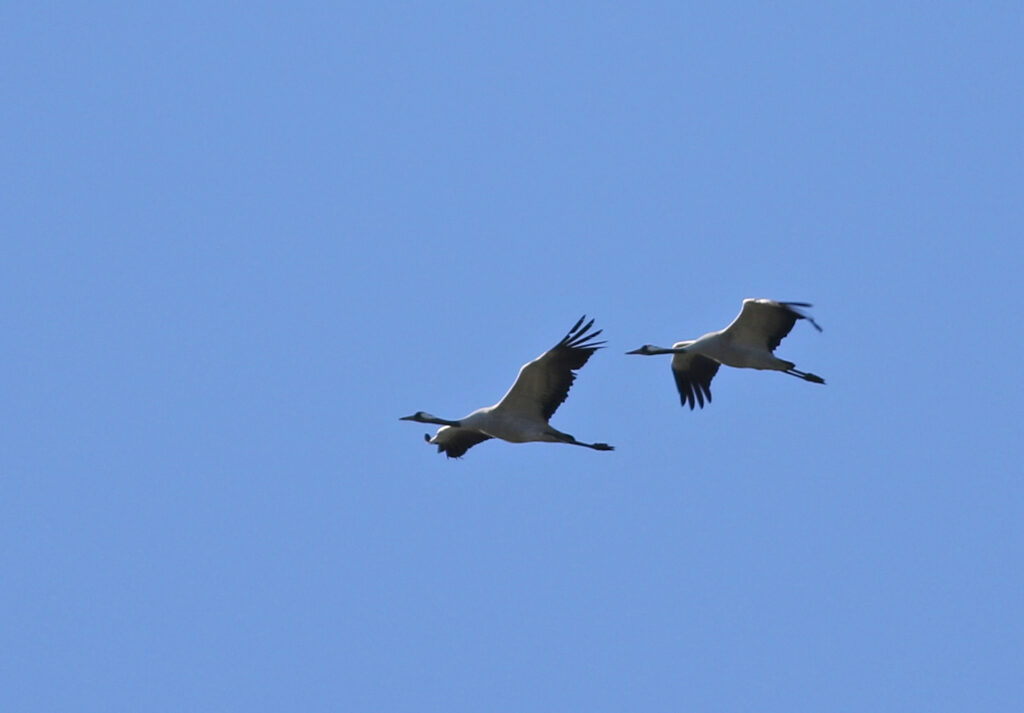
As if to underline the exceptional nature of the morning, two Common Cranes appeared shortly after the kite’s departure, flying overhead and providing a memorable coda to an already remarkable encounter.

Common Crane

The Black-winged Kite Elanus caeruleus is a small raptor with a wide but historically fragmented distribution, occurring across sub-Saharan Africa, the Indian subcontinent and parts of Southeast Asia. In Europe, however, its story is one of recent and remarkable expansion.

Formerly scarce north of the Mediterranean, the species has increased dramatically in Spain and Portugal since the late 20th century, where it is now a widespread and locally common breeder. This expansion has continued into southern and western France, with breeding populations now well established and steadily advancing northwards. Birds now nest as close as the Calais region, placing the species within easy reach of Britain.

Against this backdrop, the Black-winged Kite’s long-awaited arrival in Britain felt increasingly inevitable. The first confirmed British record in Powys in April marked a landmark moment, fulfilling decades of anticipation among British birders. That record was followed, just months later, by the individual at Stubb Mill, Norfolk—making this the second occurrence of the species in Britain.

Previous records in the Channel Islands, most notably an individual on Alderney in spring 2020, had already provided strong indications that British occurrences were imminent. These records mirror the broader European trend and suggest that Black-winged Kites reaching Britain are likely to originate from the expanding French population.

With two records now within a short space of time, and given the species’ continued population growth and northward spread on the Continent, it seems increasingly likely that further British occurrences will follow. Whether the Black-winged Kite remains a rare vagrant or becomes a more regular visitor in years to come will be watched with keen interest.


Wednesday, May 31, 2023

BLACK CROWNED NIGHT HERON-PUMPHOUSE FLASH-SANDBACH FLASHES-30/05/2023

News came through this morning that a Night Heron had been found at Sandbach Flashes. Having missed the Leasowe bird back in 2014 when I was on holiday, this would be a welcome addition to my Cheshire and Wirral lifelist. On arrival, I met up with some familiar faces and got on the bird straight away, roosting in some bushes.


There have been a good number of sightings of this species this year in Britain and Ireland, as you can see from the map below, so I was glad Cheshire had joined in with the recent run of this species; this was the 10th record for Cheshire and Wirral.


Cheshire and Wirral's previous records:

1865 Near Northenden, 16th July

1912 Marbury Country Parkon, 31st July

1962 Sandymoor Wood near Runcorn, 7th May

1982 Budworth Mere, Second summer or Adult, 6th-7th May

1987 Woolston Eyes, Second year or Adult, 26th May

1992 Budworth Mere, first summer, 16th May

1999 Elton Hall Flash, first summer, 2nd June

2002 Budworth Mere, Adult 19th April

2014 Leasowe, Adult, 23rd-27th April