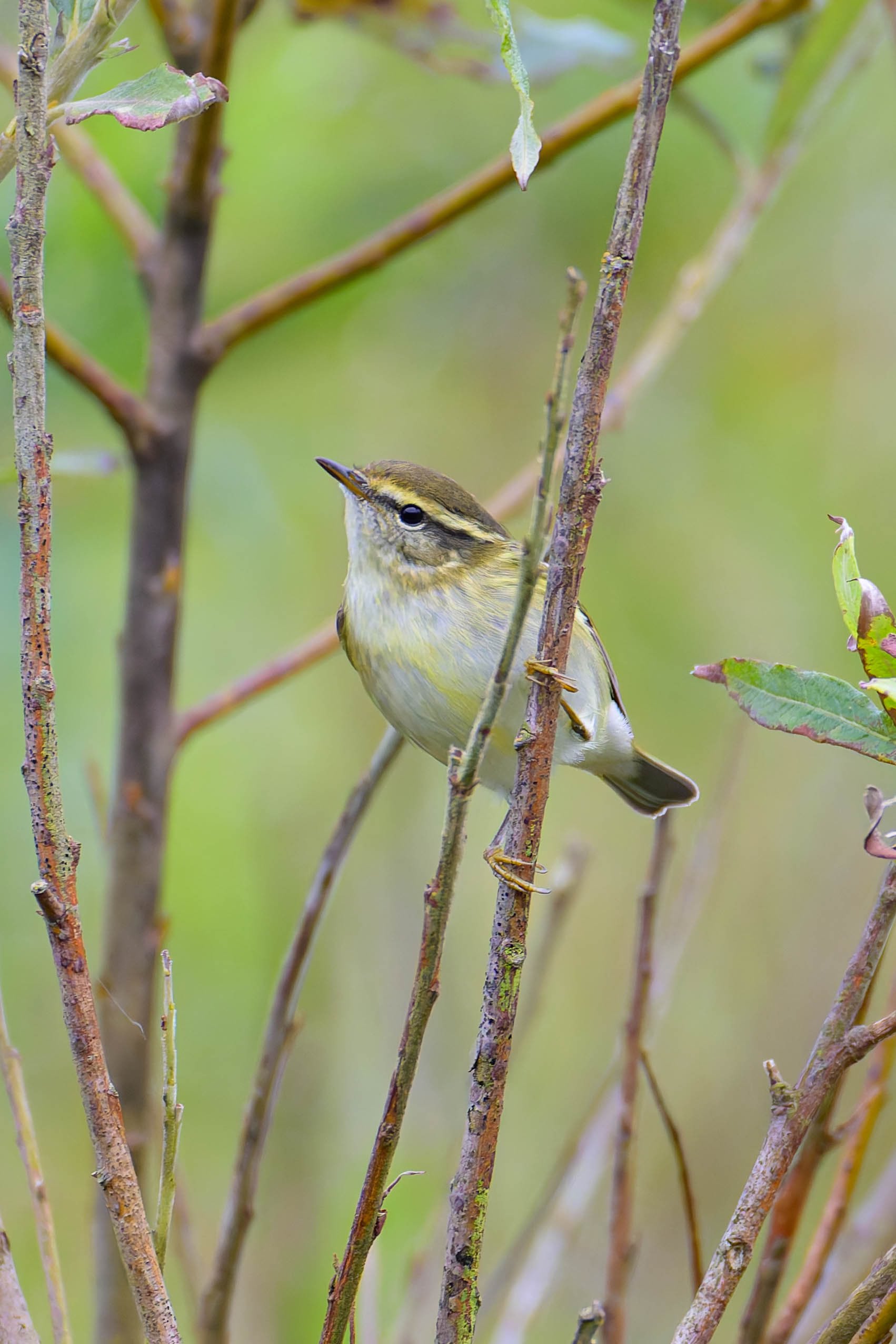
An elusive Phylloscopus warbler had been present at Bempton Cliffs RSPB, East Yorkshire, since Wednesday, initially identified as an Arctic Warbler. As observations continued, opinion shifted towards a possible Eastern Crowned Warbler. Further careful fieldwork by local observers, most notably the collection and analysis of sound recordings, eventually confirmed the bird’s true identity as a Pale-legged Leaf Warbler (Phylloscopus tenellipes).
News of the confirmed identification broke too late for immediate travel, so plans were made for an early start the following morning. Owen, Jenna, and I left at 05:30, arriving on site shortly before 09:00, where a sizeable crowd had already gathered. We joined the line of observers peering into low vegetation, a challenging prospect given the bird’s skulking behaviour and the density of cover.
After a brief initial appearance in the hedgerow, the warbler moved steadily to the right before lifting into a nearby tree, showing momentarily, and then dropping into the Dell. A quick relocation followed, and after a tense wait, the Pale-legged Leaf Warbler finally emerged, giving prolonged and excellent views that allowed many present to connect fully with this exceptional bird.
This was the first live record of the Pale-legged Leaf Warbler for the Western Palearctic.
Species account
The Pale-legged Leaf Warbler (Phylloscopus tenellipes) is an Old World warbler in the family Phylloscopidae, first described by Robert Swinhoe in 1860. It breeds in Manchuria and winters in South-East Asia.
Adults measure approximately 12 cm in length. Upperparts are brownish, with a contrasting greyish-brown crown and nape. The whitish supercilium is striking, extending well behind the eye but not reaching the forehead. The dark brown eye-stripe broadens behind the eye, while the cheeks are pale brown and mottled. The throat is whitish, with white undertail coverts contrasting against paler olive-brown rump and uppertail coverts, notably lacking any greenish tones. The underparts are whitish, washed pale brown across the breast and belly.
British context
The Bempton bird constitutes the second British record. The first involved a bird found dead after striking a lighthouse window on St Agnes, Isles of Scilly, on 21 October 2016; its identity was confirmed by DNA analysis.
A further claim from Portland, Dorset, on 22 October 2012 could not be fully substantiated, as the bird remained silent and Sakhalin Leaf Warbler could not be conclusively ruled out. A full discussion of both records was subsequently published in British Birds.
The Yorkshire bird is the second record for Britain, following one found dead after hitting a window at the lighthouse on St Agnes, Isles of Scilly, on October 21, 2016. DNA confirmed the identification of this bird.
St. Agnes' bird, which was sadly found dead.
A write-up on both birds was published in the British Birds Journal. Click on the image below.
After securing further views of the warbler through the morning, we returned to the car park, where a Yellow-browed Warbler provided a final flourish. On the journey home, we made a brief stop at Stamford Bridge, where a Hoopoe was showing superbly in a front garden, an unexpected and welcome addition to an already memorable day.


A superb day’s birding, and a pleasure to catch up with so many familiar faces. Shetland next week- bring on the mega!