News of a true mega always seems to break when you least expect it. I was sitting at home in the afternoon when word filtered through that an American Redstart had been found on Barra, Outer Hebrides. With no British records since Winchester in 1985, this was immediately a once-in-a-generation opportunity.
I called Dan Pointon without hesitation, and within minutes, the lift was sorted. The rest of the evening followed the familiar twitching routine: restless pacing, repacking gear already packed twice, and trying (unsuccessfully) to sleep. Before long, I was meeting up with my team, consisting of Simon Slade, Fred Fearne, and Malc Curtin, ready for the long haul north.
With the ferry from Uig, Skye, scheduled for 9:00 a.m., we met at 10:00 a.m. and headed north through torrential rain. Spirits remained high despite the conditions, and by 6:30a a.m., we were parked up at Uig, waiting for the ferry office to open. At 7:30am, we got confirmation that the bird was still present. Smiles all round — game on.
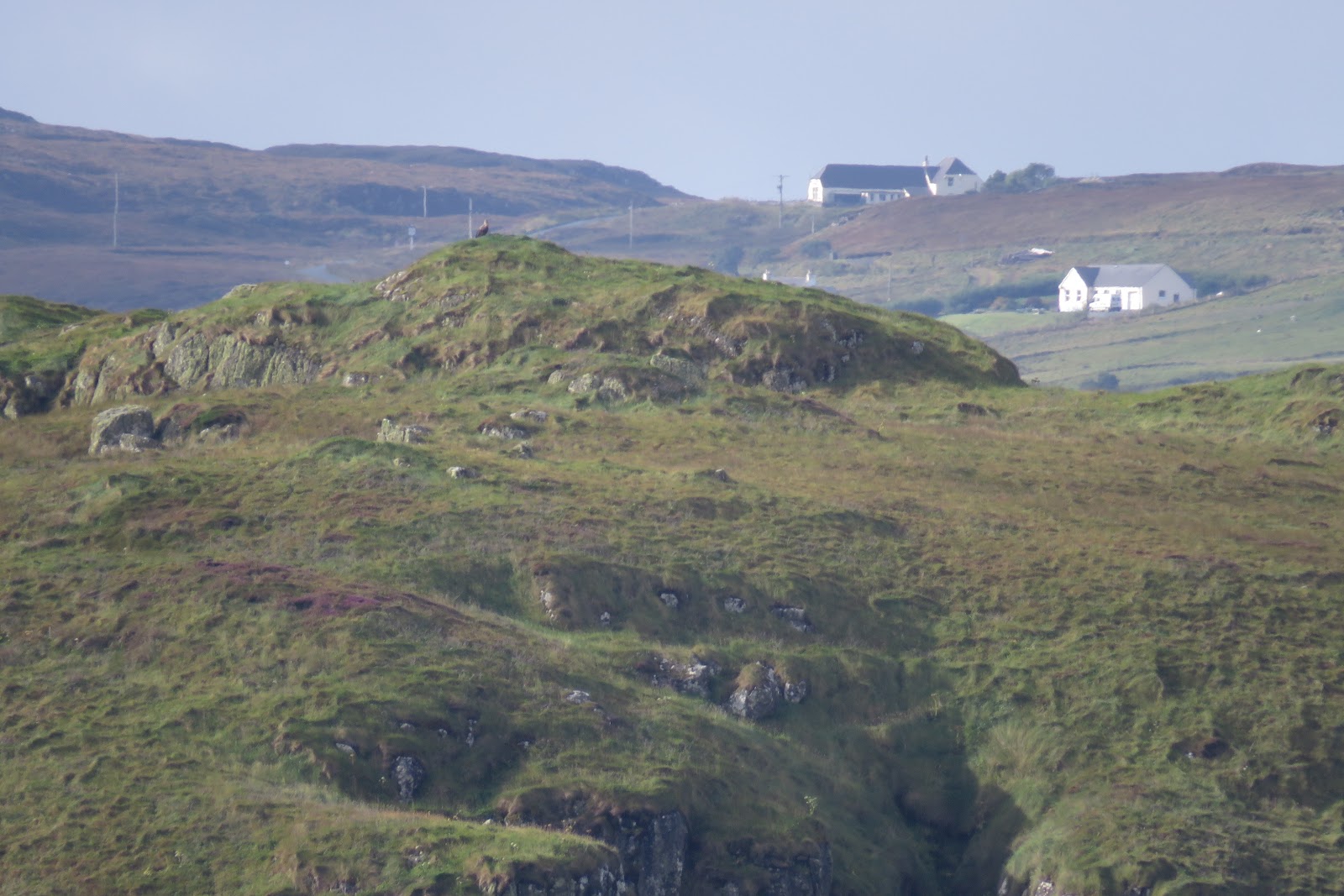
Once aboard, breakfast was taken (McBrayne-style, of course), followed by a relaxed but productive sea watch. The highlight came early with a White-tailed Eagle, perched distantly on a rocky outcrop, providing a superb start to the crossing. Other notable species included Razorbill, Great Skua, Red-throated Diver, Kittiwake, Fulmar, Storm Petrel, Gannet, Grey Phalarope, and two Leach’s Storm Petrels, with good numbers of Manx Shearwaters passing throughout.

Record shot of a White-Tailed Eagle perched up
Kittiwake
A Good number of Manx shearwaters were seen on the crossing
The team enjoying a good sea watch
We docked at Lochmaddy and made the hour-long drive south to Eriskay, leaving the car at the ferry terminal before crossing as foot passengers to Barra. A brief sea watch added further Red-throated Divers and Eiders, before local legend Steve Nuttall had us expertly organised with a bus to the site.
Twitch on
Red-throated Diver
Shags and Eiders
We're Off!
Malc and Fred just can't wait!
It didn’t take long. Shortly after arrival, the American Redstart flicked up behind the church, briefly showing in the sycamores before settling down and giving exceptional views. The bird fed actively and called regularly, allowing prolonged and relaxed observation — everything you could hope for after such a journey.
What a bird!
Sixteen hours after setting off, we had connected.
Simon and I on site
The next four hours were spent simply enjoying the moment — soaking in the bird, the setting, and the shared experience — before reluctantly heading back towards the ferry. The return crossing to South Uist was a happy one, with everyone safely “on the bird” and the pressure lifted.
Looking over Barra
What an end to a perfect day
That evening was spent in the Lochmaddy Hotel, celebrating with a few well-earned beers and feeling utterly shattered. A toast was raised to Pete Antrobus, with whom I had shared my last twitch — the Black-billed Cuckoo on North Uist the previous year. Surrounded by close friends, it felt fitting, and I couldn’t help thinking that had Pete still been with us, he would have been absolutely fuming that we’d managed to grip back another bird on him.
After a short but much-needed sleep, we caught the 7:00am ferry and headed home — in time for me to report for a 7:30pm night shift. Not bad going.
Exhausting? Completely.
Worth it? Every single mile.
Previous American Redstart records:
1985 Oct 13 to Oct 15 Co.Cork 3 days in Galley Head, 13th to 15th October.
1985 Oct 4 to Oct 6 Hants 3 days Winchester College Water Meadows, first-winter male, 4th to 6th October.
1983, Oct 13 to Oct 24, Cornwall, 12 days, St Just, first-winter male, 13th to 24th October.
1982 Nov 7 to Dec 5, Lincs, 29 days, Gibraltar Point, first winter, probably male, 7th November to 5th December, trapped 8th November.
1982 Nov 1 Argyll 1 day Portnahaven, Islay, female or immature, 1st November.
1968, Oct 13 to Oct 14, Co. Cork, 2 days Cape Clear Island, Male, 13th to 14th October.
1967, Oct 21, Cornwall, 1 day Porthgwarra, first-winter male, 21st October.